Gravure vs Digital Printing for Hot Foiling on Flexible Packaging: A 2026 Quality Guide
Gravure vs Digital Printing for Hot Foiling on Flexible Packaging: A 2026 Quality Guide
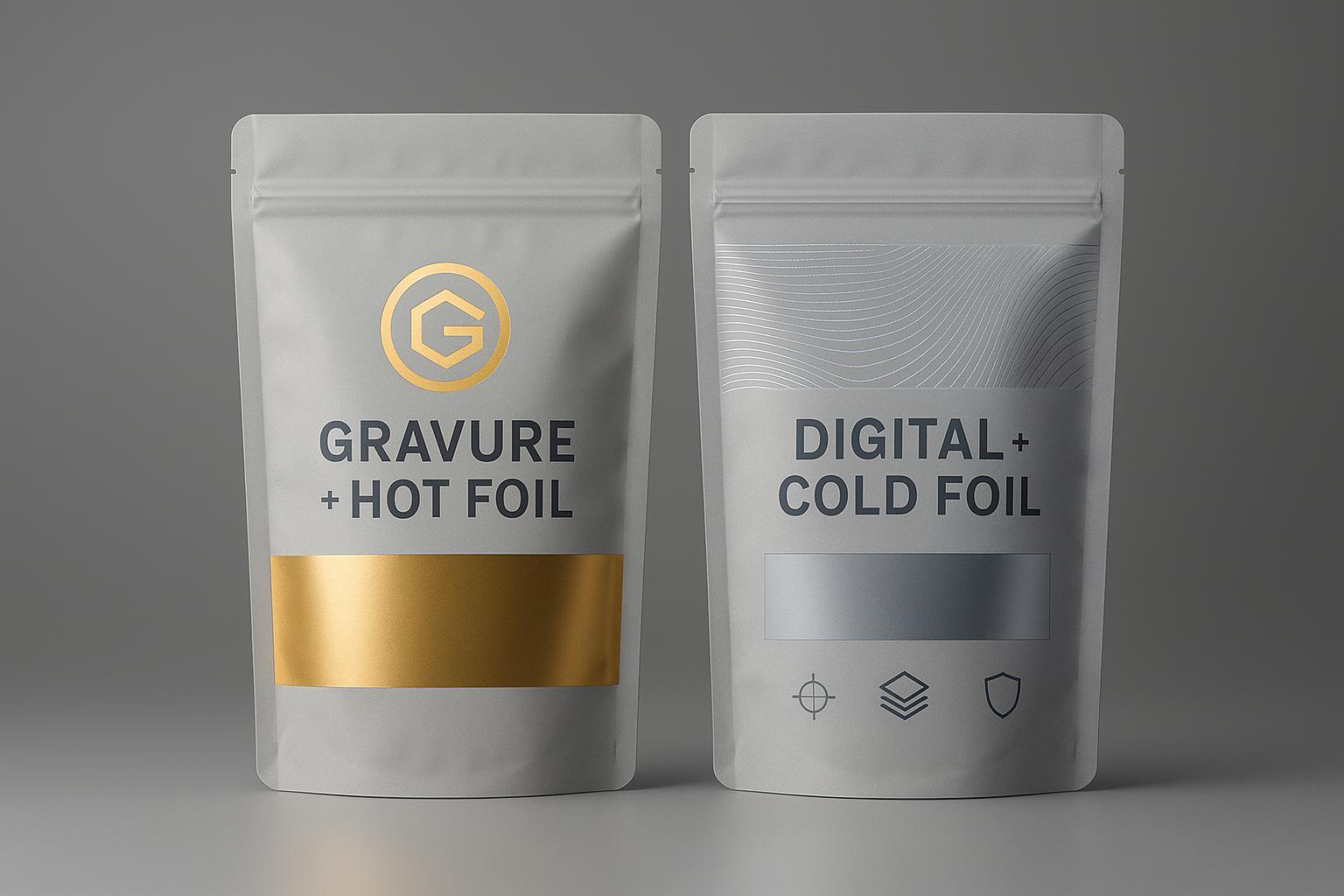
If you need premium metallics on film and consistent shelf impact across SKUs, here’s the deal: choose by stack and scenario, not by loyalty to a process. For rapid multi-SKU pilots and intricate fine details, digital printing with cold/digital foil excels. For the highest mirror-like metallic over a matte base and mass rollout repeatability, gravure paired with hot foil (or high-grade cold foil inline) is typically stronger. There’s no overall winner—only the right choice for the way you combine matte, gloss, foil, varnish, and lamination.
Gravure vs digital printing for hot foiling: which route when?
At a high level, digital + cold/digital foil is ideal for short-run speed, intricate micro elements, and quick iteration. Gravure + hot or inline cold foil is ideal for the brightest mirror metallics, the tightest repeatability across months of production, and the best unit economics at scale. The deciding factor for brand teams is almost always the intended matte–gloss stack and how it must look and feel in hand.
Why matte–gloss stacking is the decision lever for brand teams
Matte–gloss contrast is what makes foil “pop.” On flexible packaging, you aren’t only picking an inkset—you’re sequencing layers: matte lamination or OPV, foil application, spot gloss, and sometimes a second lamination. The order changes appearance, adhesion, and scuff resistance. Done right, mirror foil looks like jewelry set into a soft-touch surface. Done wrong, you get haloing around foil edges, cracked varnish over bends, or a dulled mirror effect after lamination. Because gravure and digital routes use different foils, adhesives, curing profiles, and register controls, they don’t behave identically in the same stack. That’s why the process decision must start with the intended matte and gloss combination.
Quick comparison at a glance
Below is a parity-based snapshot of gravure + hot/cold foil versus digital + cold/digital foil (sleeking) on films. Use it to narrow options, then verify on your target substrate with controlled tests.
| Dimension | Gravure + Hot Foil (or Inline Cold Foil) | Digital + Cold/Digital Foil |
|---|---|---|
| Registration tolerance | Long-run stability with advanced closed-loop register control; OEMs emphasize “perfect register quality,” but don’t publish µm figures broadly. See BOBST smartGRAVURE and Registron notes (2024–2025). | CCD-aligned embellishers commonly cite sub-0.2 mm precision; Konica Minolta AccurioShine 3600 iFoil lists ±200 μm (2025). Model-specific numbers vary; validate locally. |
| Minimum feature size | Durable for production; minimums are typically larger than digital for micro text/hairlines; validate per cylinder/foil. | Strong for fine detail; Scodix SHD supports metallic text as small as 4 pt (2025). |
| Metallic reflectance (visual) | Hot foil generally delivers the most mirror-like brilliance, especially over matte bases. | High gloss; often slightly less mirror-like than hot foil of the same grade. |
| Large-area coverage | Excellent for broad metallic panels with low pinholing when foil/adhesive are tuned. | Very good for intricate small areas; large solids may need extra tuning to avoid pinholes. |
| Matte/gloss stack options | Broad stack latitude at scale: matte lamination + hot foil; print-under-white + cold foil; spot gloss over foil with flexible OPVs; testing still required. | Highly flexible for prototypes: cold/digital foil over digital print; sleeking workflows; spot gloss windows; quick iteration to dial in sequence. |
| Substrate compatibility | Strong on PET/BOPP/NY; heat/pressure of hot foil suits heat-tolerant films; manage PE carefully. | Favorable for heat-sensitive films; rely on compatible primers/adhesives for PET/BOPP/PE/NY. |
| MOQ & lead time (typical) | Higher setup, lower unit cost at scale; lead times often 15–25 working days once approved (varies). | Low setup, faster turns; market benchmarks cite 10–15 business days and low MOQs (e.g., 5,000), with some converters offering even lower. |
| Cost pivot | Break-even shifts toward gravure as volume grows; cylinders amortize over long runs. | Best economics for pilots, short runs, and frequent versioning; per-unit cost higher at scale. |
| Best for | Luxury mirror effect over matte; national rollouts needing strict repeatability and low unit cost. | Multi-SKU short runs, rapid refreshes, micro metallic text/borders, variable data. |
| Sustainability/waste | Higher make-ready waste; solvent recovery and efficient runs improve footprint at scale. | Lower setup waste; foil-saver features on some systems reduce usage in short runs. |
| Evidence notes | smartGRAVURE/Registron (Esko–BOBST, 2024–2025); hot vs cold foil mirror consensus (converter explainers). | AccurioShine ±200 μm (Konica Minolta, 2025); Scodix 4-pt text (2025); digital lead-time benchmarks (ePac). |
Sources referenced inline below.
Matte/gloss sequencing: what to do first, second, and last
Design for the finish, not only the ink. If your hero look is a soft-touch matte field with a mirror logo and a tiny gloss window, the sequence governs success. Many teams prototype digitally to confirm whether the foil should sit directly on the print or on top of a cured matte OPV, and whether the spot gloss belongs over or under the foil. Flexible OPVs formulated for films help prevent cracking across bends, and cross-hatch adhesion testing (ASTM D3359) after 24–72 hours catches weak stacks before you commit. Digital routes make these A/B trials fast; gravure routes lock them in for repeatability at scale. When mirror sheen is non-negotiable—think prestige cosmetics—gravure with hot foil tends to keep the hot foil mirror effect even after matte lamination, provided pressure/temperature and dwell are tuned and scuff resistance is managed.
Metallic brightness and coverage (why hot foil still wins on mirror)
Industry explainers align on this: hot foil’s heat and pressure “iron” the metallic layer, delivering the strongest mirror-like reflectance. Cold/digital foils are impressively glossy, and premium SKUs can be visually close, but in side-by-sides hot foil usually looks slightly more mirror-like, especially on large panels. See consensus summaries from converters and ink suppliers such as the overviews by MTD Print and Brook & Whittle, and the guidance from INX International and Silkcards (2019–2025). Links: according to the hot vs cold foil comparisons in the overviews by MTD Print and Brook & Whittle and the technique guide by INX International, hot foil typically delivers the most mirror-like finish, while cold foil approaches it with select grades:
- MTD Print’s comparison discusses why hot foil shines more due to pressure/heat.
- Brook & Whittle outline visual differences and when to choose each.
- INX International’s guide explains process effects on shelf appeal.
- Silkcards’ explainer reiterates mirror vs satin tendencies.
For very large metallic solids, gravure paired with hot or inline cold foil often yields more uniform coverage with fewer pinholes when adhesives and nip settings are dialed in. Intricate micro elements, however, may favor digital cold foil.
Registration tolerance and minimum feature size (what’s reliably printable)
Gravure’s advantage is long-run stability with modern closed-loop register systems. Esko and BOBST announced smartGRAVURE color/register governance in late 2024, and BOBST’s Registron claims “perfect register quality” in production communications (2025). While those pages don’t publish µm tolerances, the message is clear: stability at speed over long runs. On the digital embellishment side, there are published numbers you can use as planning proxies: Konica Minolta’s AccurioShine 3600 iFoil brochure lists ±200 μm registration accuracy (2025), and trade overviews describe sub-0.2 mm typical CCD precision for modern systems. For tiny foil text and hairlines, Scodix SHD-capable systems document metallic text down to 4 pt. Put simply: if your layout includes micro metallic compliance icons or hairline borders hugging clear windows, digital cold foil is often the safer first prototype. If your program demands millions of units with the same crisp border month after month, gravure’s stability pays off.
Citations: see Esko’s 2024 smartGRAVURE news and BOBST’s 2025 register-control notes; see Konica Minolta’s 2025 AccurioShine brochure and Scodix 2025 datasheets.
Color gamut and consistency near metallics
Digital presses employ automated color governance and inline spectro routines that help hold brand colors tightly across short runs; gravure achieves excellent batch-to-batch consistency on long runs through cylinder durability and process control. As a practical target many brands use ΔE below roughly 2 for critical solids, but set thresholds with your converter and proof on your actual film near foil edges, where metamerism and haloing can trick the eye. Esko–BOBST smartGRAVURE work emphasizes closed-loop control; HP Indigo materials reference automated calibration, though across-run ΔE figures aren’t commonly published. Keep your expectations qualitative unless your supplier shares measured logs.
Run-length economics, MOQ, and lead time (with simple math)
TotalCost = Setup + (UnitPrice × Quantity). Digital’s Setup is low, UnitPrice is higher; gravure’s Setup is high (cylinders, make-ready), UnitPrice drops fast with volume. Market benchmarks for digital converters cite “most orders ship within 10–15 business days” and low MOQs around 5,000 units in multiple markets as published by a leading digital flexible packaging provider in 2024–2025. For a concrete feel, many converters list digital pilots in the 10–15 day range and gravure production in the 15–25 working day range after approvals—illustrative only, as of 2026-02-09 and varying by region and program complexity.
For readers who prefer examples and supplier context, Henan Baolai offers both gravure and digital routes. Disclosure: Henan Baolai Packaging Co., Ltd. is our product. On select product pages, Baolai notes digital printing lead times around 7–10 working days and gravure at roughly 15–25 working days, alongside low-MOQ digital options. See contextual pages such as the digital-ready coffee packaging overview and the custom stand-up pouch page for capability menus. Always verify live timelines and MOQs during quoting.
- Market benchmark for digital lead times and MOQs: see the statement “Most orders ship within 10–15 business days” and low-MOQ examples on ePac pages (2024–2025).
- Baolai capability/contextual pages (internal): see the coffee packaging page and the custom stand-up pouch page.
Scenario mini-cases you can map to your next launch
- Multi-SKU short-run pilot (≤3k per SKU): Use digital printing with digital/cold foil. You can iterate artwork and finish stacks in days, use CCD alignment for overlays, and approve a look that scales later.
- Luxury matte pouch with mirror gold logo: Favor gravure printing with hot foil for the brightest mirror look over a matte base. Sequence testing should confirm whether the matte sits under or over the foil and where the spot gloss window behaves best.
- Micro metallic text near a clear window: Start with digital cold foil or sleeking. SHD-class imaging enables very small type and hairlines; validate minimums on your film.
- National rollout (millions of units): Gravure becomes compelling. Register stability and unit costs at scale outweigh the upfront cylinder investment.
- Heat-sensitive films or stacks prone to curl: Digital + cold foil avoids high heat/pressure, reducing risk of distortion; choose adhesives/primers tuned to your film.
Migration guide: pilot digitally, then scale to gravure
Many brands lock the creative and stack digitally, then shift to gravure for scale. The workable pattern is simple: begin with a digital pilot to validate artwork, foil sheen, and matte/gloss windows on your target substrate. Agree on color aims and generate a reference ICC profile and ΔE targets. When you move to gravure, request a cylinder proof and measure ΔE and registration against the approved pilot; adjust underprint/white or trapping before mass production. During the first scaled run, schedule periodic QC checks—every 50k units is a common rhythm—to catch drift early. Suppliers who run both processes can help keep the look consistent through this handoff.
FAQs
Q: Which route gives the most mirror-like gold on a matte pouch? A: Gravure with hot foil generally delivers the highest mirror brilliance; high-grade cold foils can be close. This mirrors findings summarized by multiple converter explainers published between 2019 and 2025.
Q: Can I apply spot gloss over foil without cracking? A: Yes, with flexible OPVs/varnishes and proper cure; verify by cross-hatch adhesion and scuff testing after 24–72 hours because stacks differ by substrate and chemistry.
Q: How small can metallic text be on films? A: Digital embellishment systems with SHD-class imaging document text down to about 4 pt; always test on your film to confirm legibility and edge cleanliness.
Q: What’s the typical lead-time and MOQ difference? A: Digital often ships in 10–15 business days at low MOQs depending on region and converter; gravure generally runs 15–25 working days with higher MOQs after approvals, as of 2026-02-09.
Evidence and further reading
- Esko–BOBST smartGRAVURE partnership highlights closed-loop register/color governance (2024): according to the Esko announcement on innovative smartGRAVURE, closed-loop controls support stability in gravure production: Esko partners with BOBST on smartGRAVURE.
- BOBST references “perfect register quality” with ACCUREGISTER in production communications (2025): see the BOBST news item on investment and register quality: BOBST register control note.
- CCD registration proxy for digital embellishment: Konica Minolta details ±200 μm on AccurioShine 3600 iFoil (2025): AccurioShine brochure.
- Trade overview summarizing sub-0.2 mm register precision for modern CCD systems: Digital embellishment transforming print.
- Fine-detail capability reference: Scodix SHD documentation noting metallic text as small as 4 pt (2025): Scodix Ultra 6500 Series and Scodix Ultra 2500 Series.
- Hot vs cold foil mirror-brightness consensus: converter and supplier explainers (2019–2025): MTD Print comparison, Brook & Whittle overview, INX International technique guide, Silkcards explainer.